System for Lightening Two-Way Reinforced Concrete Flat Slabs
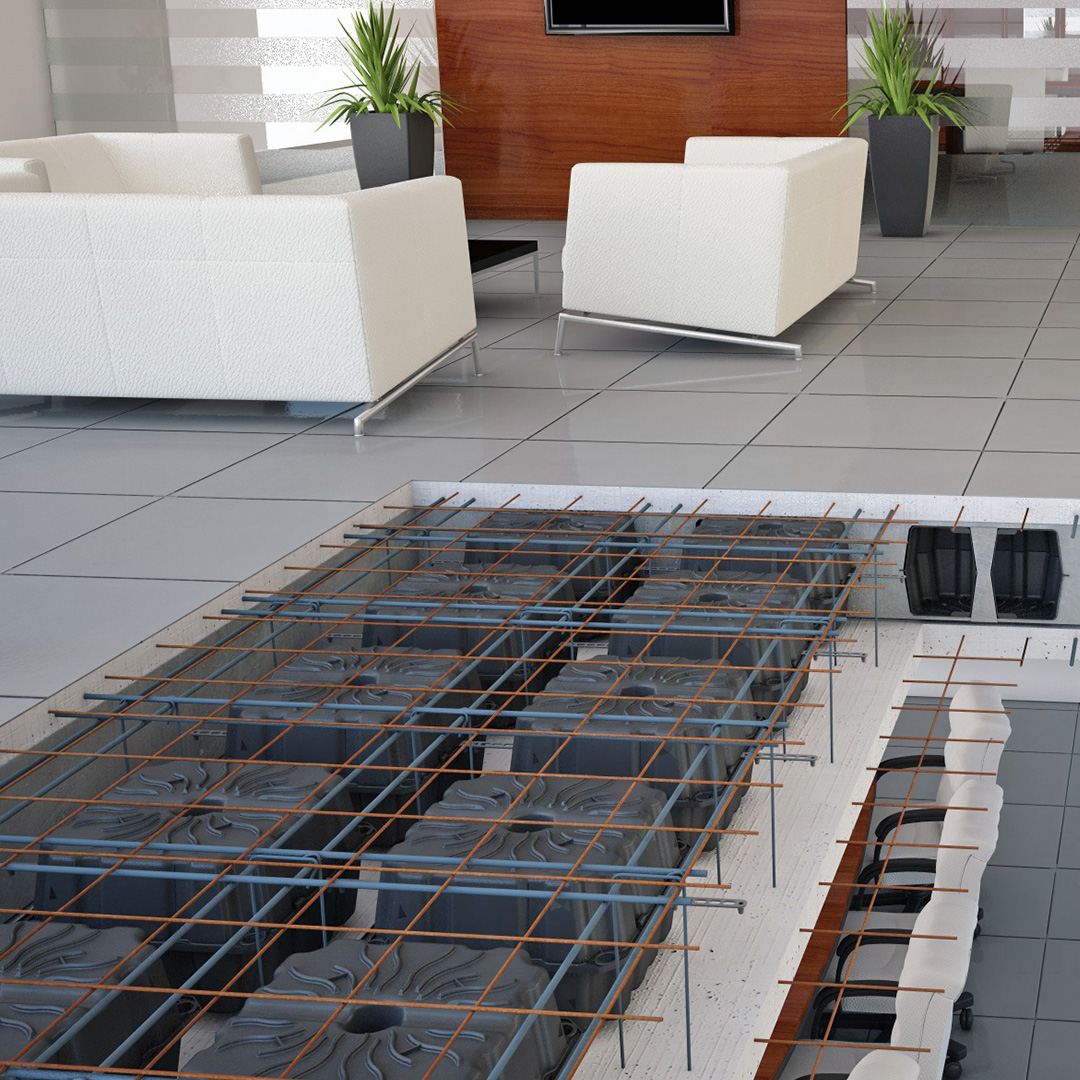
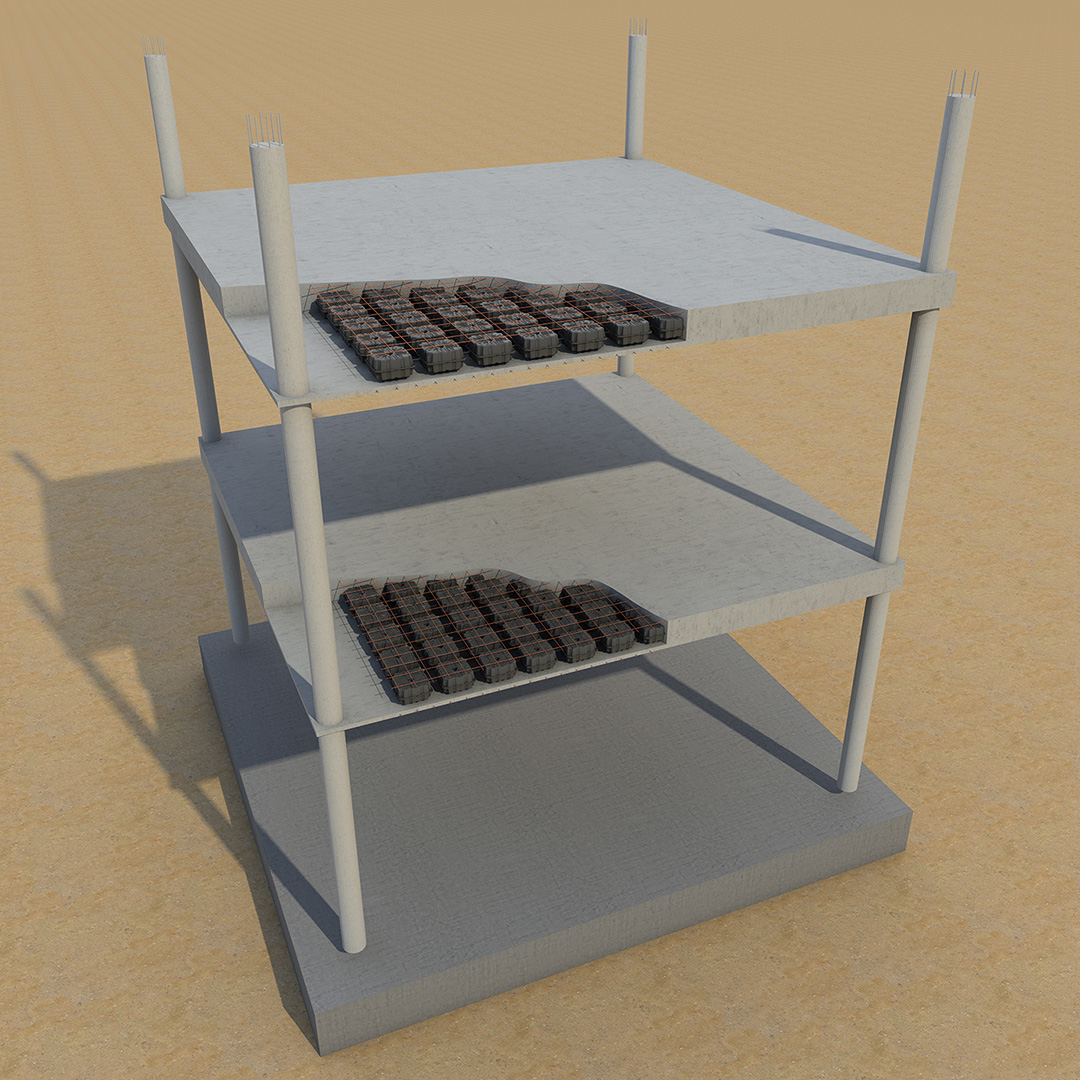
New Nautilus Evo is a lightweighting system made of recycled plastic for cast-in-place reinforced concrete two-way flat slabs. The formwork remains embedded in the concrete pour and allows the creation of a continuous flat slab both above and below the element, generating a grid of orthogonal ribs that replaces traditional drop panels, integrating them within the slab thickness.
The reduction in the slab’s self-weight (up to 25–30% compared to solid slabs) allows significant savings in concrete and reinforcing steel, with benefits extending to columns, shear walls, and foundations. In addition, the lightweighting makes it possible to increase spans and load-bearing capacity without adding beams, improving the static and seismic performance of the entire structure.
The distinctive feature of Nuovo Nautilus Evo is the hollow central cone, which facilitates filling during concrete placement, improves concrete flow, and prevents the formation of air pockets, ensuring continuity and quality of the resistant section. The design allows visual inspection of the proper formation of the bottom slab, reduces the risk of formwork uplift, and ensures a uniform, defect-free soffit finish.
Lightweight, modular, and quick to install, the system offers high operational safety on site and maximum geometric adaptability, making it ideal for large-span or high-load slabs with optimized material use and reduced overall costs.
Advantages
HIGH STRUCTURAL PERFORMANCE
Nautilus enables the construction of high-performance lightweight slabs by creating a two-way ribbed slab with high load-bearing capacity and reduced concrete usage. The reduction in structural mass results in lower seismic forces and allows for more slender foundations.
REDUCTION OF MATERIALS AND STRUCTURAL MASS
The system allows up to 30% savings in concrete and up to 15% reduction in steel reinforcement, lightening the slab and improving both economic and environmental efficiency.
SPEED AND SIMPLICITY OF INSTALLATION
Lightweight, modular, and stackable elements ensure fast and safe installation without dedicated equipment, optimizing transport and site logistics.
MAXIMUM DESIGN FREEDOM
The system easily adapts to complex, curved, or inclined geometries. Slab thicknesses and configurations can be customized with full freedom in the layout of vertical structural elements. The two-way action of the slab allows the elimination of beams, achieving large spans of up to 20 m and completely flat soffits, ideal for building services and architectural finishes.
DEDICATED TECHNICAL SUPPORT
The technical team provides assistance from feasibility studies through to detailed design, simplifying the design process and optimizing performance and material use.
CERTIFIED SUSTAINABILITY
Made from 100% recycled polypropylene, the system is EPD-certified and contributes up to 8 LEED credits. It ensures high thermal and acoustic performance and fire resistance up to REI 120, meeting the most advanced standards of sustainable construction.
COMPLIANCE WITH EUROCODE STANDARDS
Nautilus is designed to be fully compliant with structural Eurocodes, ensuring calculation reliability, safety, and international applicability in reinforced concrete structures.
CASTING CONTROL THANKS TO THE CENTRAL CONE
The cone allows immediate visual control of the filling of the bottom slab and ensures the complete formation of the structural section.
LIMITATION OF FORMWORK UPLIFT DURING CASTING
The cone geometry stabilizes the formwork during concrete placement, preventing unwanted movement and improving the final slab quality.
ELIMINATION OF AIR BUBBLES IN THE CONCRETE
The conical shape promotes the release of trapped air, reducing voids and internal defects for a more homogeneous and durable structure.
GREATER WALKING STIFFNESS DURING INSTALLATION
The cone increases the surface stability of the module during operational phases, improving safety on site.
Solutions
Lightweight flat slabs
Lightweight two-way slabs
Lightweight ribbed/grid slabs
Lightweighting systems for predalles and foundation slabs
Construction of lightweight slabs for buildings:
Commercial
Healthcare
Educational
Residential
Parking garages
Religious buildings
Sports facilities
Construction of lightweight roofs, including inclined roofs
How much concrete can be saved compared to a ceiling slab solution?
When calculating a plate made with NEW NAUTILUS EVO, the parameter defining its thickness and governing its sizing is the deformation, which is a function of the inertia of the concrete + steel section. By replacing part of the concrete with the empties of the NEW NAUTILUS EVO formworks, the inertia will tend to reduce, but the lightness compensates for this loss as the weight reduction is greater than the reduction in flexural inertia. In general, however, weight reduction and therefore consumption of concrete varies between 20 and 30%.
How much steel can be saved compared to a ceiling slab solution?
The overall reduction in load depends on the extent of permanent and variable loads, as well as from the lightening ratio of the plate to the full load. This reduction varies between 5 and 15%. On average, steel savings on floors are around 10%. This savings should be added to the reduction of seismic stresses, the reduction in foundation load and the lower stress of vertical structures under static load.
Contact Federico Minaldo
Request information
//Show ZOHO chat on Geoplast.it English
Notice
This website or its third party tools use cookies, which are necessary to its functioning and required to achieve the purposes illustrated in the cookie policy. If you want to know more or withdraw your consent to all or some of the cookies, please refer to the cookie policy. By closing this banner, scrolling this page, clicking a link or continuing to browse otherwise, you agree to the use of cookies.